
While there are many interpretations of Kubrick's 2001, I have not yet seen one that connects the film to the simulation theory. In short, the simulation theory is essentially all about the idea that we are in a simulation and nothing is "real". There have been many works of fiction that revolve around the idea of a simulated reality; a famous example is the 1999 sci-fi film 'The Matrix'. For the sake of keeping this post simple and clear, I will assume that you're familiar with the story of The Matrix, and I will now draw allusions to the simulation theory for 2001.

The simulation theory suggests that the world we live in is a simulation and that there is a base reality (or as Morpheus calls it "the real world"), which is outside of our simulated reality. Of course, like a computer simulation, the simulated reality is thought to have been controlled by simulators (the people who exist in base reality and are controlling the simulation), which I think seems to fit the characteristic of extraterrestrial beings behind the Monoliths from 2001. The monolith is first shown to have an influence over the Apes, then, later on, it sends Bowman through the stargate and lands him inside of an ominous room, one that seems very alien. All of this has been suggested by many fans as a sign that these Monoliths are a way for advanced extraterrestrial beings to watch over, influence, and control humans.

And because of the nature of these Monoliths and the mysteries about the people behind them, I would say that it's not so far-fetched to suggest that the world Bowman once knew of (before he traveled through the stargate) could be a simulated reality, created by the same people behind the Monoliths and the room at the end of the film. The room Bowman walks around at the end of the film suggests that he has entered base reality, and the limitations of our reality are not present; hence Bowman's ability to see himself aging as if the passage of time is quicker there (though I do believe that it could also only be Kubrick's way of speeding up the story).
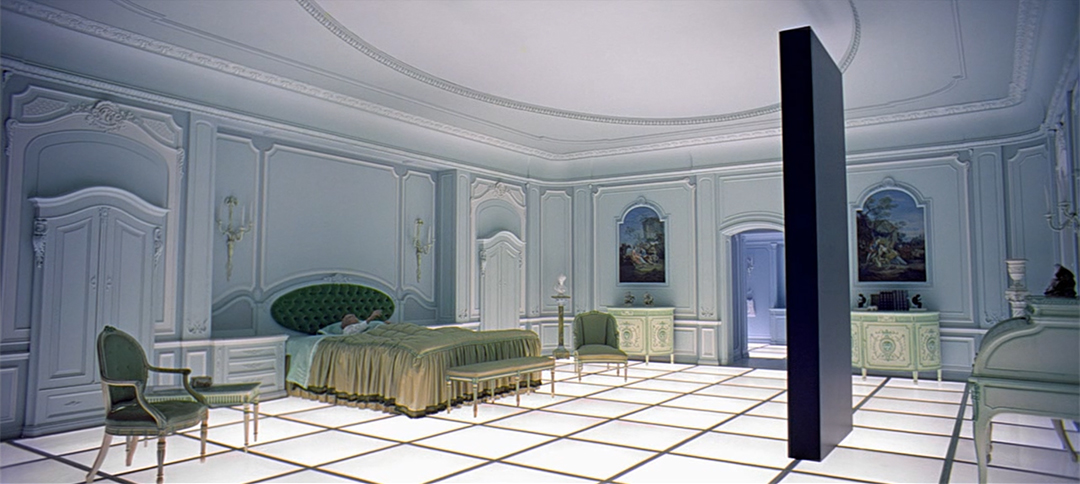
I know Kubrick and Clarke had a science fiction film about the mysteries of the universe in mind, and most likely did not intend to suggest the simulation theory, but once I thought about the simulation theory and watched the film again with this mindset; it surprised me how strangely likely the connection could be. While the current popularized version of the simulation hypothesis was published by Nick Bostrom in 2003, many works of fiction had alluded to the idea of a simulated reality decades before. Examples of this are the early stories by Philip K. Dick from the late 1950s and early 1960s, or more notably "Simulacron-3" by Daniel Galouye in 1964. This hints at the possibility that Kubrick may have read such works and was influenced by them, but that's only a guess.

So what do you think? Is the connection between Kubrick's 2001 and the simulation theory a convincing one? I would suggest re-watching the film with the mindset that Bowman's world is a simulation and that the Monoliths are devices created by extraterrestrials from base reality, it really changes everything.
If anything, I find the idea of it very fun and interesting. Thank you for reading.
- Bal Masque
Comments
Post a Comment